Self Guided Tour: May 2026
Marvelous Blooms of May
Contributor: Lyn Anderson, VanDusen Volunteer Guide
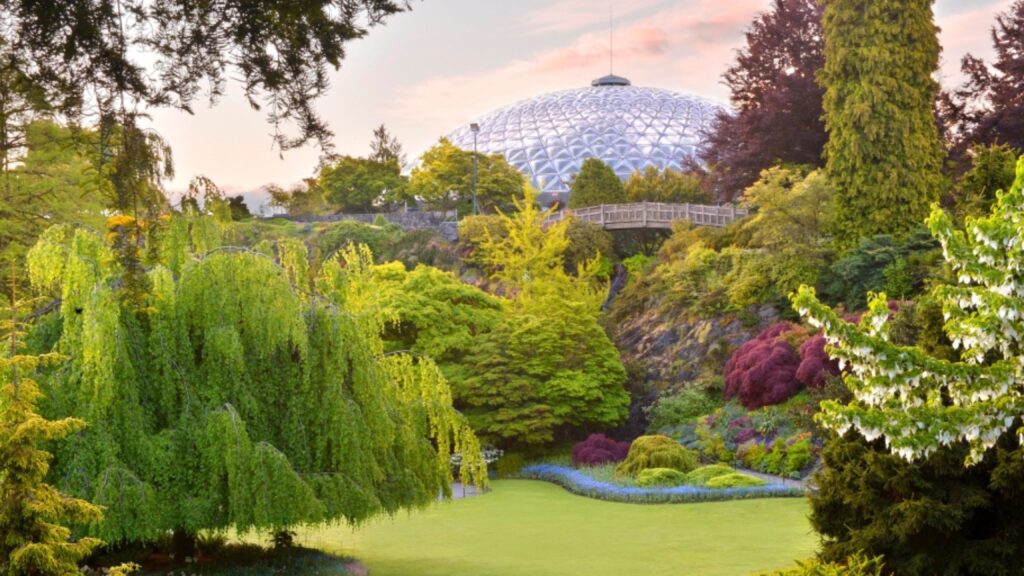
Welcome to VanDusen Botanical Garden’s 55 acres at one of its most colourful times of the year. This tour is a continuation of the Spring 2026 self-guided tour and may repeat some of the plant stories. Blossoms seem to appear overnight, so come to the Garden often as you can. If you are visiting from afar, we hope you enjoy your time in the Garden and perhaps return in the future.
Enter the plaza, turn left and walk over to the North American Cultivars Garden. The first stop is 1 – Garry oak (Quercus garryana). The Garry oak is the only oak native to British Columbia and Washington State. Only 5% of original Garry oak ecosystems remain in BC today. In pre-colonial days, First Nations set prescriptive fires in Garry oak meadows to perpetuate the grasslands, which were habitat for food plants. The acorns produced once the tree is 30 years old are an important food source for animals and humans.
2 – Great Camas (Camassia leichtlinii ‘San Juan’) grows up to 4’ tall. Great swaths of camas once grew throughout southern Vancouver Island, the Gulf Islands and Whitbey Island in Washington State. Camas bulbs are an important traditional food source for Indigenous Peoples. The bulbs are roasted to make them edible and to be stored for winter use.
Walk over the bridge, past the jade fountain on your left, opposite, on your right is 3 – Bollwiller Pear (× Sorbopyrus auricularis), also known as shipova. This tree is dedicated to Erica Dunn, one of the first guides trained in 1974. The × at the beginning of its botanical name indicates an intergeneric hybrid, in this case between Aria edulis (whitebeam) and Pyrus communis (pear). It was first seen in Bollwiller, Alsace, France in the early 1600s. The blossoms turn into beautiful thumb-sized pears in the fall. The pears are edible, not so juicy, but palatable.
Take the mid path past the pond, on your left is our Fragrance Garden showcasing 4 – late Dutch honeysuckle (Lonicera periclymenum ‘Serotina’). It is a vigorous growing vine treasured for its colourful honey-scented flowers. Be aware – the berries are poisonous. Stop and smell the flowers in this bed.
Continue to the end of the path, to your right is 5 – golden southern catalpa (Catalpa bignonioides ‘Aurea’). The long seed pods are remnants of last year’s blooms’ showy blossoms. While it is not in bloom at this moment, it has an interesting story.
This tree has an ecological relationship with caterpillars (Ceratomia catalpae) that may defoliate the tree many times in the summer without killing it. The caterpillars are used as fishing bait in the southern USA. Fishing enthusiasts freeze the caterpillars for a year-round supply of bait.
Turn left at the junction, follow the curved path until you reach 6 – handkerchief, dove or ghost tree (Davidia involucrata). The specific epithet involucrata means “with ring of bracts surrounding several flowers”. Two white bracts, one larger than the other, protect the flower’s pollen from the wind and rain. As the mature white bracts flutter in the breeze, they also absorb UV light to attract pollinators.
The genus Davidia is named for Father Armand David who encountered a lone tree in the mountains in Sichuan Province in southeastern China in 1869. In his 12 years in China, French Catholic missionary, zoologist and botanist Father David not only learned the language and celebrated the culture but collected and documented an abounding array of flora and fauna unknown in the western world. He also described the giant panda (Ailuropoda melanoleuca) after being shown the skin by local hunters.
You are now at the base of the Rhododendron Walk. Most of the rhododendrons on your left are cultivars developed in England and Holland. On your right are azaleas, formerly a separate genus Azalea, now in the genus Rhododendron. To tell the difference, azaleas have 5 stamens and rhododendrons have 10 or more. Another difference is most azaleas are deciduous, such as 7 – Rhododendron molle subsp. japonicum. Coral or orange red flowers are produced before the oblong leaves in spring. This azalea is rare in gardens today. It is the parent of many yellow ones readily available in garden centres.
Much further up the path opposite the Magnolia & Hydrangea sign is an interesting 8 – rhododendron (R. yakushimanum ‘Mist Maiden’). Note the fuzzy brown lining on the underside of the leaves known as indumentum (Latin for “robe” or “garment”). It functions as a protective layer that sheds water and insulates in dry cold weather. New leaves have silver hairs.
Continue up the paved path, near the end is the Japanese Collection. 9 – Wasabi (Eutrema japonica ‘Mazuma’) has been used in traditional Japanese medicine and cuisine for over 1000 years. The entire plant is edible, but wasabi is mainly grown for the root, which is grated to make a spicy paste. It was unknown in North America until the introduction of sushi in the 1900s. It is rare, delicate, and takes a few years to mature. Its natural habitat is along rocky riverbeds in mountainous areas throughout the Japanese archipelago and north to Sakhalin Island. Fresh wasabi lasts for a short time, making it prohibitive to export. The “wasabi” served in most Canadian sushi restaurants is horseradish dyed green.
At the end of the path turn right. You are in the heart of the Sino-Himalayan Garden. VanDusen’s vast collection of species rhododendrons (those that grow naturally in the wild) are here along with many other plants indigenous to China and the Himalayas. Follow the winding path until you reach the junction.
Just before the path’s junction, on your right is a small bed of 10 – hybrid Himalayan blue poppy (Meconopsis × sheldonii). This hybrid, a cross between M. baileyi and M. grandis, is thought to have occurred independently in the early 1930s. It was recorded by William George Sheldon in 1934 and named for him in 1936. In 1937, it was received the Award of Merit by the Royal Horticultural Society.
Turn right and follow the path to the Hon. David C. Lam Cherry Grove named after a Lieutenant-Governor of British Columbia (1988-1995). As you look across the Great Lawn, you can imagine it was once the first hole fairway on the 18-hole Shaughnessy Golf Course. Each May long weekend the lawn is host to the All British Field Meet, a car show started in the early years of the Garden by Roy Foster CM, first Curator and the proud owner of a BRG (British racing green) MG sports car. 400 vintage British vehicles take part each year.
Continue down the path, turn left at the intersection, then right over the bridge. The 11 – Scottish shelter, built of local basaltic rock, enhances VanDusen’s Heather Garden. Traditionally, this structure would have a thatched roof of heather, but for safety reasons, natural slate is used here. Heather (Calluna vulgaris) is often associated with Scotland; however, it is also native to the moorland of Europe, Iceland, the Faroe Islands and the Azores. Amongst the heather in this garden, you can see winter heath (Erica carnea) and may ask what the difference is. Both are in the family Ericaceae and were once the same genus. Heather is now in the genus Calluna, and heath remains in the genus Erica. Their leaf structure differs. An easy way to remember is heath has teeth (needle like) and blooms in winter and spring. Heather has feathers (overlapping scales) and blooms in summer and autumn.
Enter the Grotto, look up at the 12 – spreading yew (Taxus baccata ‘Repandens’). Yew trees are dioecious, having separate male and female plants. Bright red fleshy seed structures called arils will appear in the fall on this female yew. There is much folklore surrounding yews and well worth time spent reading about it. Exit the grotto, turn left, cross the bridge, follow the path on your left.
13 – giant rhubarb (Gunnera manicata) with huge leaves and enormous flower spikes. This genus dates back 95 million years. It nourishes itself by a symbiotic relationship with cyanobacteria, which live in glands located along the stems and provide the plant with essential nitrogen. The inflorescence consists of cone-shaped spikes and can grow up to two meters tall. The plant dies back for the winter, but springs back to life in the late winter, growing to full height at an accelerated rate!
Ahead of you on the path is 14 – Lake Lolog barberry (Berberis × lologenis) native to Argentina and Chile. Bright orange flowers in spring soon turn to blue black berries. If we are lucky, it will bloom again in the fall. Lake Lolog barberry is not a significant host for black stem rust, unlike common barberry, which is listed as a prohibited noxious weed in Canada. Take the adjacent pathway, cross the bridge.
Continue down the path until you reach 15 – hybrid magnolia (Magnolia × brooklynensis ‘Yellow Bird’). Brooklyn Botanic Garden has bred several yellow hybrid magnolias with ‘Yellow Bird’ having the most intense yellow flowers. Canada’s only native cucumber tree (Magnolia acuminata) is used to breed yellow magnolias. Turn right at the end of the path, follow it to the end.
16 – largeleaf cucumber tree (Magnolia macrophylla), is native to the Southeastern United States. This species has the largest leaves of any deciduous tree in North America, reaching 80 cm (nearly 32 inches). Its snow-white blossoms are dinner plate size, and the fruits are long and cucumber shaped.
The Magnolia Family (Magnoliaceae) is ancient, dating back 95 million years ago (mya). Its range is widespread but fragmented because it has survived many geological events such as the ice age. This family has two known genera: Magnolia and Liriodendron.
Across the path is 17 – tulip tree (Liriodendron tulipifera). The ancestors of Liriodendron evolved before bees and like magnolia species are pollinated by beetles. The emerging flowers are large yellow tulip shaped and are hard to see due to the height of the tree. Check the lower branches for blooms.
We hope you enjoyed the colourful blooms and stories in VanDusen’s southeast quarter of the Garden!