Bloedel Conservatory
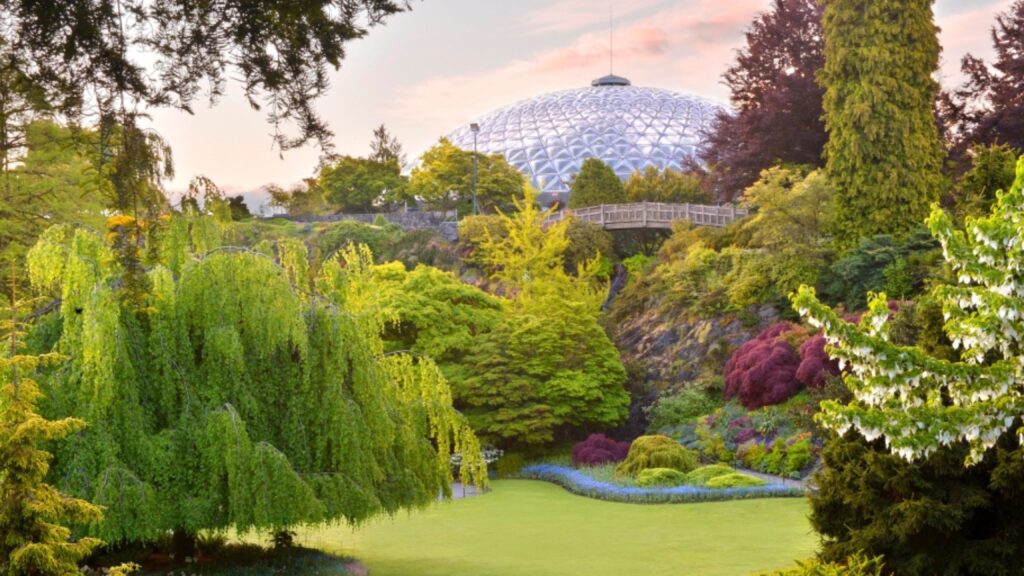
Bloedel Conservatory is a domed lush paradise located in Queen Elizabeth Park atop the City of Vancouver’s highest point. Tropical birds, koi fish, and over 500 exotic plants and flowers thrive within its temperature-controlled environment.
Tickets are available online or at the admission desk. Save when you book online! View opening hours here.
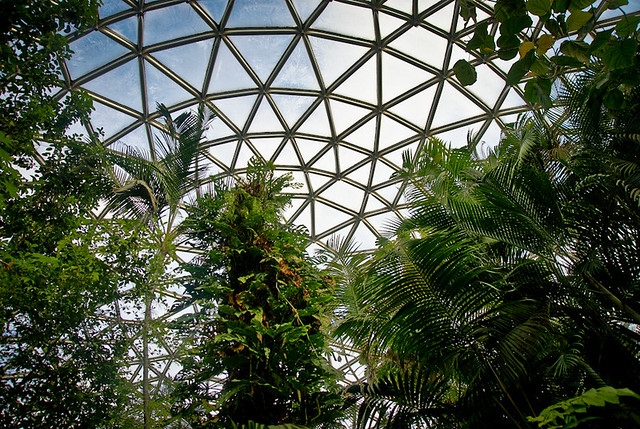
Bloedel Conservatory is home to over 500 plants from tropical and subtropical rainforest habitats, along with a variety of exotic birds—all of the large perch birds at the Conservatory are rescues. The koi pond is another highlight, featuring Dragon Gate, believed to be the oldest koi fish in Vancouver. Originally brought to Vancouver for Expo 86’, Dragon Gate later resided at Dr. Sun Yat-Sen Classical Chinese Garden before being rehomed to Bloedel Conservatory in 2020 after surviving two infamous river otter attacks in 2018 and 2019.
You will find red, blue, and dwarf macaws, an African parrot, parakeets, cockatoos, and more at Bloedel. Don’t be surprised if they answer when you say hello!
Each bird under our care receives dedicated attention and regular avian veterinary oversight to ensure their physical and emotional needs are met.
All of the larger perch birds are rescues that had their wings clipped. They were saved from poor living conditions or even dangerous situations, had outlived their owners, or could no longer be cared for by the people who had purchased them as pets. Bloedel Conservatory works directly with local bird sanctuaries, and many of the larger perch birds have come from these non-profit organizations. These birds have never been in the wild and lack the necessary skills and instincts to survive in the wild. The Conservatory and other organizations provide a loving and safe environment, ensuring they are not left without a home.
Our birds are provided with enrichment activities and toys to stimulate them mentally and physically. We continuously evaluate and adjust their environment to ensure it promotes their well-being and encourages natural behaviors. Additionally, our avian diet plans are meticulously designed to meet the nutritional needs of each individual species under our care. The birds are fed fresh food throughout the day on a routine schedule.
In 1966, while Canada prepared for its Centennial celebrations, two men in Vancouver had a grand vision. Stuart Lefeaux, Superintendent of the Vancouver Board of Parks and Recreation, and Deputy Superintendent Bill Livingstone wanted to do something that would enhance the image of Vancouver. Their vision was to build a Conservatory for exotic plants that would not only be educational, but would also be a beautiful place to visit.
They approached Prentice Bloedel, of Macmillan Bloedel Limited, who put forward $1.4 million, in conjunction with contributions by the City of Vancouver and the Provincial Government, to build the Bloedel Conservatory, the fountains and the surrounding plaza. This was the largest civic gift given to Vancouver to date.
The elements for the triodetic dome frame were manufactured in Ottawa and shipped 3,000 miles across the country to Queen Elizabeth Park. Once it arrived, the aluminum framework was erected in just 10 days although the entire Conservatory structure took over 1 year to complete. With unerring guidance by Charles Coupar, Bloedel’s first Garden Director, Stuart Lefeaux, Bill Livingston and Prentice Bloedel, the Grand Opening of the Conservatory took place on December 6, 1969 and hosted over 500,000 people in its first year of operation.
In 2009, the city approved a new management approach to the Conservatory. Building on the success of its collaboration at the VanDusen Botanical Garden, the City of Vancouver Board of Parks and Recreation and the Vancouver Botanical Gardens Association entered into a joint-operating agreement for the Conservatory.
Explore a rotating collection of orchids including Cattleyas, Vandas, and Dendrobiums, displayed among Bloedel’s more than 500 tropical plants. The VOS Orchid Display was created in partnership with the Vancouver Orchid Society to celebrate orchids — one of the most diverse plant families on Earth.
The installation highlights the remarkable variety of orchids found across nearly every habitat on Earth. With more than 28,000 species and over 100,000 hybrids cultivated around the world, orchids represent roughly 10% of all seed plant species. The featured orchids will change throughout the year — ranging from delicate slipper orchids to long-petalled Bulbophyllum — ensuring each visit offers something new to discover.
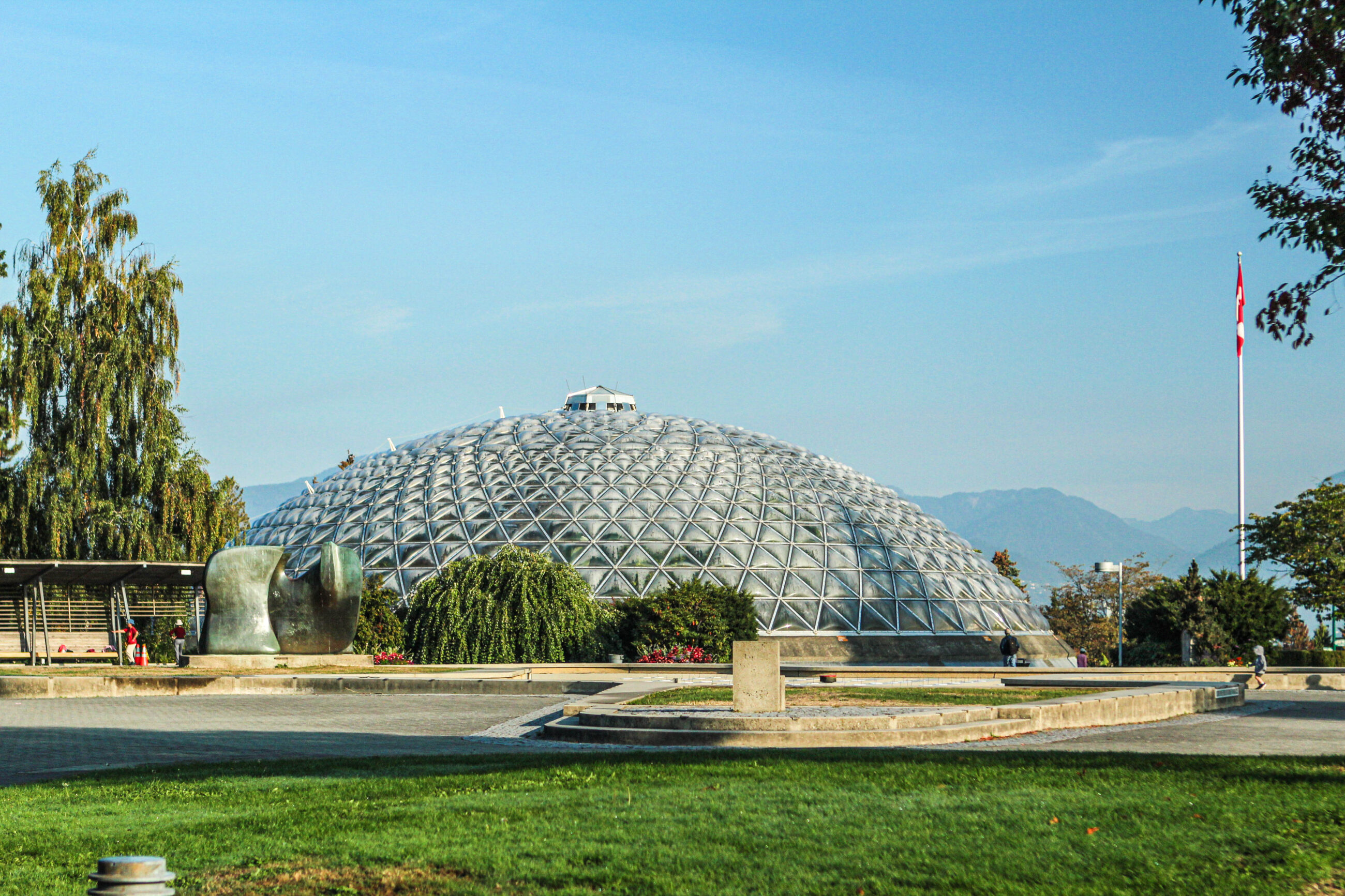
The Conservatory dome structure consists of 2,324 pieces of 5-inch diameter extruded aluminum tubing and 1,490 plexiglass bubbles set in aluminum glazing. It measures 140 feet in diameter, 70 feet high and covers 16,386 square feet (nearly ¼ acre) of display area. The Bloedel Conservatory was the first large triodetic dome conservatory in Canada.. It sits at the geographic centre and the highest point in the city of Vancouver. It has been awarded the first Vincent Massey Award for Excellence in Urban Environment (1971) and was designated as a City of Vancouver “Class-A” Heritage building in 1996.
Prentice Bloedel and his wife Virginia were also widely known as avid art collectors. Not only did they contribute the majority of funding to build the Bloedel Conservatory and the surrounding plaza, they also gifted the striking Henry Moore bronze sculpture, Knife Edge – Two Piece. This sculpture can be seen next to the fountain in the Conservatory plaza. Moore created the sculpture in 1962, and authorized three castings of the work. The first stands on John D, Rockefeller’s New York estate; the second stands outside the Palace of Westminster, London, England; the third Knife Edge was the first non-commemorative sculpture accepted by the Vancouver Park Board.
Bloedel Conservatory’s iconic dome-shaped roof was replaced in 2014. This large and complex project replaced all 1,400 acrylic panels of the conservatory over seven months.
Project Details
This was a large and unique project as the dome structure has more than 1,400 individual “bubble” panels of 32 different sizes. While the conservatory roof was strong, the original roof was more than 40 years old. Some individual roof panels needed to be replaced because they had cracked and were leaking.
What happened during construction
The replacement of the roof was a multi-phase process.
Phase one of the project replaced:
- The centre dome panels
- The roof section over the building entrance
- The fan and ventilation system
Scaffolding covered the entire dome, as shown in the cross-section diagram. Due to the unique structure, special scaffolding was used to cover – but not touch – the dome. A protective cover wrapped around the scaffolding.
Phase one was completed in spring 2014. The remainder of the roof project, or Phase two, was completed by late summer 2014.
Keeping birds, plants, and visitors safe
Special care and attention was paid to protecting the conservatory’s beautiful birds, exotic plants, and visitors during construction. Protective netting was used inside the dome to ensure no birds escaped and no outside birds could enter, and to catch any falling debris.